 Newsletter Signup
Writing The Bristol Suffragettes
Posted on 2nd April, 2015 in The Bristol Suffragettes
Some “frequently asked questions” about how I came to write The Bristol Suffragettes…
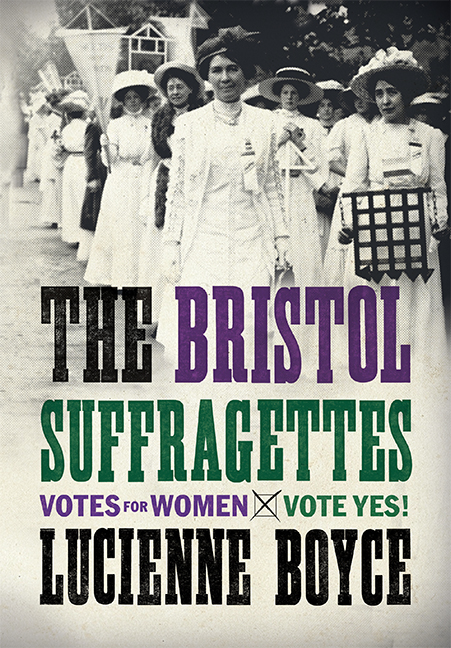
What sparked your interest in the local suffragette movement?
Until a few years ago, I had no idea the suffragettes were so active in Bristol. Then one day I was browsing at a market stall in Bristol’s Corn Exchange where they sold old photographs and postcards. I came across a picture taken in 1913 of a group of women standing under the banner: “Women’s Suffrage Societies: Land’s End to London”. The women were wearing badges in their hats, and rosettes and sashes, and carrying decorated shoulder bags. Of course, the picture was in black and white and I didn’t know what the colours were, but I was intrigued. Who were these women, were why they dressed in uniform, and what were they doing?
And they were suffragettes?
No! As a matter of fact it turned out that the women I was looking at were not suffragettes: they were a west-country contingent of law-abiding suffragists and they were taking part in the Suffrage Pilgrimage of summer 1913. They are wearing the colours – red, white and green – of the non-militant National Union of Women’s Suffrage Societies (NUWSS) who organised the Pilgrimage. Travelling from all corners of the United Kingdom, hundreds of women walked to London, giving talks and holding meetings in towns and villages on the way, to meet in a mass rally in London’s Hyde Park on 26 July 1913. The west country route started at Land’s End.
During their pilgrimage, the NUWSS women faced violence and hostility. In Cheltenham they were pelted with eggs and mobbed. In Cirencester, students dressed up as women and drowned out the speeches with their heckling, while many of the suffragists were attacked and had their clothes torn. In Portsmouth, pilgrims were subjected to obscene insults. The opponents of women’s suffrage didn’t always distinguish between militant and non-militant campaigners!
But I soon realised that it was an important distinction. The women in the photographs were not suffragettes. They didn’t break the law and they didn’t go to prison for the cause. And at first I didn’t think much of it. Like many people, I’d thought of the suffragette campaign as being something that happened in London: the battles around the House of Commons, demonstrations in the Ladies’ Gallery, the Hyde Park rallies, hunger strikes in Holloway. But while I was trying to find out about the picture, I began to come across incidents in Bristol: windows broken, buildings burned, politicians attacked – and women in Horfield Prison on hunger strike and being forcibly fed. The more I looked into Bristol’s suffrage history, the more names and events I discovered – not the big names, and not the headlining events (although some did hit the headlines!). And it was those less well known women I wanted to commemorate.
You’ve included a fold-out map and walk in the book. Why did you think that was important?
The more I discovered about what happened in and around Bristol, the more intrigued I became. I’d be walking past the Colston Hall and I’d think, oh, suffragettes hid in the organ here. Or along Small Street, and I’d recall that here suffragettes broke the Post Office windows. The thought that I was walking in the suffragettes’ footsteps fascinated me. So the walk is an invitation to readers to join me in that walk. There are also some free, downloadable walk “add ons” on my website that you can do as additions to the walk in the book, or as stand-alone strolls.
There are also extracts from some of my talks, and the Spotlight On feature which commemorates women – and men – who were active in Bristol and beyond: Lillian Lenton, Edith New, Ellen Pitman and many others.
These questions were originally prepared to celebrate the publication of the SilverWood Selection Box in 2015, a selection of tasters from ten SilverWood authors. The Selection Box is no longer available.